Azo Bladder Control: What It Is, What It Does, and How It Compares to Other Overactive Bladder Options
The short answer
Azo Bladder Control is a daily capsule sold over the counter to help with bladder urgency, frequent urination and occasional leakage. Its listed ingredients are pumpkin seed and soy germ extracts. It is not a prescription medicine and does not treat urinary tract infections. Whether it suits you depends on your symptoms, your other medicines and your health history, and a clinician can help you decide.
Some links on this site are affiliate links: if you buy through one, the site may earn a commission at no extra cost to you. More about this.
Here is what this guide covers:
- What the product contains and what the label does and does not claim
- How it compares with prescription medicines, other over-the-counter options, lifestyle changes and natural remedies
- What the evidence shows for each option, and where the evidence is thin
- Who should avoid each option, and which symptoms mean you should see a clinician first
- Side effects and drug interactions to check before you start
If you have been waking three or four times a night, rushing to the toilet, or leaking when you laugh or cough, you know how much of your day it can take over. You want fewer sudden urges and fewer trips to the toilet, and you would rather not start a prescription just to find out whether something simpler works. That is a reasonable place to start, and you deserve a straight answer rather than a sales pitch.
This page is built to give you one. You will see every realistic option side by side, with the evidence behind each, who should avoid it, and when a doctor's assessment matters more than trying something at home.
Azo Bladder Control and Alternatives at a Glance
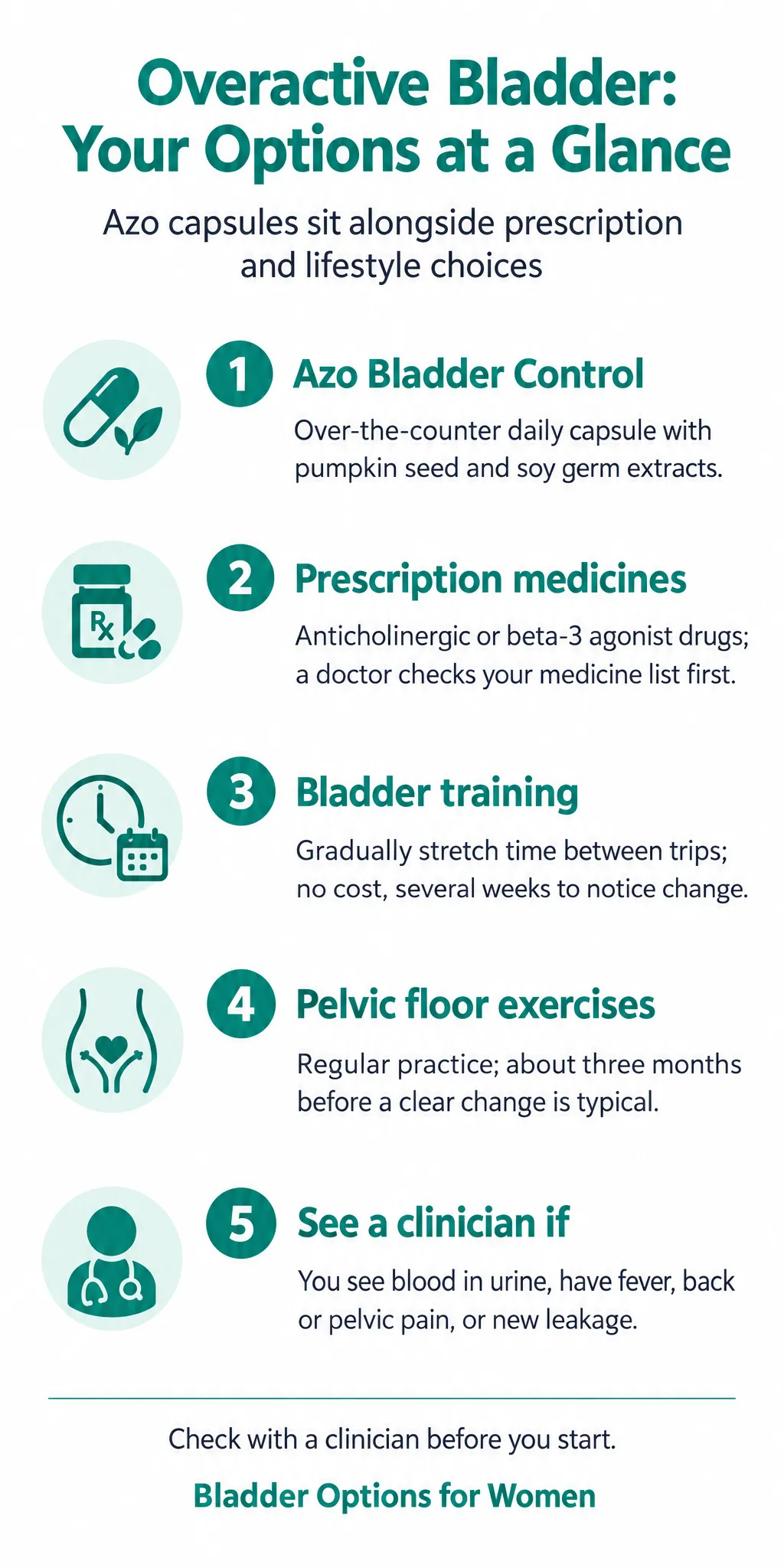
| Option | Best for | Key feature | Prescription needed |
|---|---|---|---|
| Azo Bladder Control capsules | Low-effort trial, mild symptoms | Pumpkin seed and soy germ extracts | No |
| Prescription anticholinergic medicines | Persistent or disruptive symptoms | Calms bladder muscle; dry mouth, constipation | Yes |
| Beta-3 agonist medicines | People who cannot tolerate anticholinergics | Relaxes bladder; fewer dry-mouth complaints | Yes |
| Bladder training and timed voiding | First-line, no cost | Gradual stretching of trip intervals | No |
| Pelvic floor exercises | Leakage with cough or laughter | Needs about three months for clear change | No |
| Reusable pelvic support device (Uresta) | Leaks during exertion, non-capsule option | Reusable insert; single reviewer's experience | No |
Guides on this site
What Overactive Bladder Is and When Symptoms Need a Doctor
Overactive bladder, often shortened to OAB, is a pattern of symptoms rather than a single disease. The usual signs are a sudden, hard-to-ignore urge to urinate, needing to go often during the day, and sometimes waking at night to pass urine. Some women also leak urine when the urge hits and they cannot reach the toilet in time. The bladder is contracting when it should be relaxed, and that is why the urge feels so abrupt.
It is easy to confuse OAB with a urinary tract infection, since both can cause frequency and urgency. A UTI often brings burning or pain when you pass urine, cloudy or strong-smelling urine, and a feeling that the bladder is never fully empty. If your symptoms are new and you have any of those signs, a urine test is the quickest way to find out what is going on.
Some symptoms should not wait for a routine appointment. See a clinician promptly if you notice:
- Blood in your urine, even once
- Fever, chills, or feeling generally unwell
- Pain in your back, side, or pelvis
- A weak stream or straining to empty your bladder
- New urinary leakage, especially if you never had it before
Other causes can produce the same symptoms as OAB. Certain medicines, including some diuretics and drugs for blood pressure or mood, can increase urination. Diabetes raises blood sugar and makes you pass more urine. Pelvic organ prolapse, where pelvic tissues sag, can cause urgency, incomplete emptying, and pressure. A clinician can check for these before you settle on a self-treatment plan, so that you are treating the actual cause.
What Azo Bladder Control Is and What Is Actually Known About It
Azo Bladder Control is a capsule sold as a daily supplement. It is not a medicine, and it is not prescribed or regulated the way a drug is. The listed ingredients are pumpkin seed extract and soy germ extract. You take the capsules by mouth, following the directions on the pack. The product is sold under the Azo brand, which makes several other products that you should not confuse with this one.
The brand describes its ingredients as clinically studied. That wording needs care. Studies of pumpkin seed or soy germ extracts in general are not the same as independent trials of this exact capsule in women with overactive bladder. The first tells you something about the ingredient; the second tells you whether the finished product helps the people who take it. As far as this page can establish, the second kind of evidence is what buyers most want and is least clearly available.
Azo's range includes other items, including a men's version. Those are formulated for different purposes, so check the label and the product name before you buy. Grabbing the wrong one is an easy mistake when items share a brand name.
What you can reasonably take from this:
- The capsule is a daily supplement, not a treatment licensed for overactive bladder.
- The ingredients have been studied, but mostly not as this capsule.
- The "clinically studied" claim does not by itself show that Azo Bladder Control works for you.
- Other Azo items, including the men's version, are not the same as the bladder control capsule.
If your symptoms are frequent or disruptive, a clinician can assess them and talk through options that have stronger evidence behind them.
Side-by-Side: Azo Bladder Control, Prescription Medicines, Lifestyle Changes and Other Options
If you have overactive bladder, the sudden urge and the trips to the bathroom can wear you down, and you may be weighing several routes at once. This section puts the main options next to each other so you can see where Azo bladder control capsules fit.
What are the prescription options, and what do they cost you in side effects?
Prescription treatments for overactive bladder mostly fall into two groups. Anticholinergic medicines calm the bladder muscle, and beta-3 agonist medicines relax it in a different way. Anticholinergics commonly cause dry mouth, constipation, drowsiness and blurred vision, and they can interact with other medicines, so your doctor will check your full list first. Beta-3 agonists tend to cause fewer dry-mouth and constipation complaints, though they can raise blood pressure in some people.
What can you do without medicine?
Non-drug options are often the first step recommended, and they have a solid track record:
- Bladder training: gradually stretching the time between trips, usually over several weeks.
- Pelvic floor exercises: regular practice, often needing about three months before you notice a clear change.
- Timed voiding: going to the toilet on a fixed schedule rather than waiting for urgency.
- Adjusting fluids and caffeine: cutting back on coffee, tea, fizzy drinks and alcohol, and spreading fluids through the day.
Expect a few weeks to start noticing a difference from habit changes, and longer for the full effect.
Where do Azo bladder control capsules and other over-the-counter products fit?
The capsules are best suited to people who want to try something low-effort before a doctor visit, or who have mild symptoms. Other over-the-counter and supplement products vary widely in what they contain and how much research supports them. Evidence strength differs from one product to the next, and many have only limited or mixed studies behind them. A product that suits one person may do little for another, so treat it as a trial rather than a guarantee.
Safety, Side Effects and Who Should Avoid Azo Bladder Control
Before you buy any product for overactive bladder, check the label and talk to someone who knows your health history. Azo Bladder Control is sold as an over-the-counter supplement, which means it is not reviewed for safety and effectiveness in the way a prescription medicine is. That does not make it dangerous, but it does mean the warnings matter.
Who should check with a clinician first
- Anyone who is pregnant, trying to become pregnant, or breastfeeding. The label carries warnings for these groups, and there is often little reliable data on supplements in pregnancy.
- Anyone taking blood pressure medicine or other prescription drugs. Ingredients in a bladder supplement can interact with medicines, so ask your doctor or pharmacist before you start.
- Anyone with a kidney, liver or heart condition, or a history of urinary retention.
Can I take Azo Bladder Control with my other medicines?
Bring the product label and a full list of your prescriptions to your pharmacist. They can check for interactions faster than you can search for them.
What side effects should I watch for?
Stomach upset or a change in bowel habit is the most common complaint with supplements of this kind. If either happens, speak to a pharmacist or doctor rather than pushing through. Stop taking the product and get advice if side effects are severe or do not settle.
When is a supplement not enough?
A supplement is not a substitute for assessment. If your symptoms are new, getting worse, or come with red-flag signs such as blood in your urine, fever, pain in your back or pelvis, or a sudden inability to pass urine, see a doctor promptly. These signs can point to infection or another condition that needs proper diagnosis.
Reusable Pelvic Support Devices as a Non-Capsule Option
If you would rather not take capsules at all, a reusable pelvic support device is one non-capsule option that some women look at. These are inserted into the vagina and are meant to support the bladder area during activity. They work differently from medicines, and they belong to a different category from the capsule products most people compare when they search for Azo bladder control.
Dr. Bri, who runs the Vibrant Pelvic Health channel, reviewed Uresta, a reusable device sold over the counter. Her opinions are based on her own use, not on clinical testing, so treat them as one person's experience:
- She prefers Uresta to Poise Impressa because Uresta is reusable. She says Poise Impressa has to be thrown away after each use and contains plastic.
- She found the smallest size, size three, the most comfortable for her, and said the range lets you step up or down for more or less support.
- She uses it only during activities such as walks or runs, not all day, and says she can still pee with it in place.
- She recommends a water-based lubricant on the device and advises against oil-based products on the vulva before insertion.
- She says Uresta is not designed as a prolapse support device. It is meant for bladder leaks during exertion, which she believes it helps by pinching off the urethra.
Keep in mind that these points come from a single reviewer. They are not evidence that the device works for you. If you have a pelvic support problem, such as a feeling of heaviness or bulging, a clinician should assess it before you rely on any device. Pelvic support is not something to manage with a product alone.
How to Choose, Cost Over Time and Next Steps
If you are dealing with sudden urges, frequent trips to the toilet or leaks, a simple sequence helps you decide what to do next.
- Confirm your symptoms and rule out infection first. A urinary tract infection can cause urgency, frequency and burning, and it needs different treatment. A urine test at a pharmacy or your clinic is a quick way to check.
- Try lifestyle steps for a few weeks. Cutting back on caffeine and alcohol, spacing fluids through the day, and doing pelvic floor exercises are low-cost and worth doing before anything else.
- Consider a supplement trial if you want a low-effort option. Azo bladder control capsules are available without a prescription. Read the label, check the ingredients against your current medicines, and decide in advance how long you will try them.
- See a clinician if symptoms persist, or if you have blood in your urine, pain, or problems emptying your bladder. Prescription options exist, and a clinician can tell you whether something else is going on.
How do I work out what a product costs over time?
Start with the label. Divide the number of capsules in the container by the number you take each day to get the number of days one bottle lasts. Then divide the price you paid by that number of days to get a daily cost, and multiply by 30 to get a monthly cost. Check the current price on the retailer's site, since prices change and a sale price may not last. Compare the regular price with any sale price to see what you are really paying.
Compare that monthly figure with the cost of other options: a pharmacy urine test, a clinic visit, a prescription, or a reusable device. A cheap product you take for years can cost more than a single appointment, so weigh the total over the period you expect to use it.
Azo bladder control gives you a clear, low-effort starting point. Whether it works for you is a separate question, which the evidence and buyer reports pages cover in more depth.
What hands-on reviewers found
These are other people's hands-on tests, summarised and credited to them. Watch the full videos for their complete reviews.
Dr. Bri's Vibrant Pelvic Health: Uresta Review for Bladder Leaks and Pelvic Support 💖 Reusable, Over-the-Counter
Dr. Bri thinks Uresta is a practical, reusable, over-the-counter option that gives her mild prolapse support during activity, most comfortable at the smallest size, though it is not designed as a prolapse device and works best combined with
- The reviewer says she feels supported for her very mild prolapse when using Uresta, especially when constipated, though she does not experience bladder leaks. (at 8:23)
- She finds the smallest size, size three, works best for her, and says the sizing range lets users step up or down for more or less support. (at 10:10)
- She prefers Uresta because it is reusable, unlike Poise Impressa, which she says must be thrown away after each use and contains plastic. (at 10:44)
- She finds Revive intimidating to use, so she considers Uresta the most user-friendly of the reusable options she tried. (at 13:43)
Frequently Asked Questions
How do you take AZO Bladder Control?
Follow the directions on the package and do not exceed the labeled dose. Take it with water as the label instructs, and do not take more than one product containing the same active ingredient. If you are unsure whether the dose or timing suits you, check with a pharmacist before starting, especially if you take other medicines.
Is it safe to take AZO while breastfeeding?
Breastfeeding mothers should check with a doctor or pharmacist before taking any over-the-counter urinary product, because many ingredients can pass into breast milk. Information on a given product's safety during breastfeeding may be limited, so a clinician who knows your medical history and your baby's age can give a clearer answer than a label can.
Does AZO help the bladder?
AZO Bladder Control is marketed to help with urinary urgency and discomfort, but the strength of evidence behind it is limited. Some people report relief, while others notice no change. Whether it helps depends on the cause of your symptoms, so it is a reasonable thing to try only if you understand it may not address the underlying problem.
How long does it take for an AZO bladder to work?
Product labels and reports vary, and there is no reliable published timeline for AZO Bladder Control specifically. If you notice no improvement after the period stated on the label, or your symptoms get worse, stop taking it and speak with a healthcare provider. Persistent urgency or leakage deserves a proper assessment rather than waiting it out.
Is AZO Bladder Control the same as a prescription overactive bladder medicine?
No. Prescription overactive bladder medicines are regulated drugs with established dosing and known effects on the bladder, while AZO Bladder Control is sold over the counter with different ingredients and a different level of supporting evidence. A clinician can explain which option fits your symptoms and health history.
Wrapping Up
Over-the-counter products like AZO Bladder Control can be a low-effort first step, but they are not a substitute for knowing what is causing your symptoms. If urgency or leakage keeps disrupting your day, a doctor's assessment is the right next move.
Have you tried an over-the-counter option for overactive bladder? Share what you noticed in the comments, including anything that did or did not help.
If you want to compare the product details for yourself, visit the official site to read what the manufacturer says before you decide.